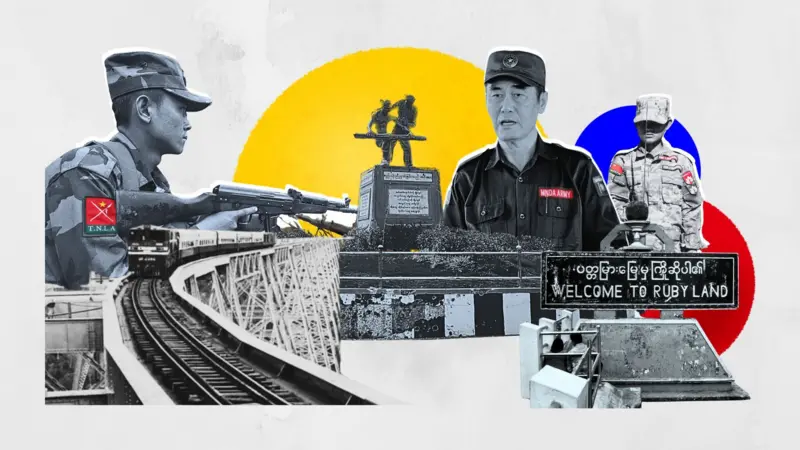
The year 2025 has been a rollercoaster for Myanmar. What started with the resistance forces seemingly on an unstoppable march has ended in a complex, grinding stalemate. If 2024 was the year the military was “shaken,” 2025 was the year it dug its heels in, leveraged its airpower, and used its diplomatic ties with China to claw back lost ground.
The Great Reversal
The most sobering statistic of the year is the 14 towns the military managed to retake from resistance hands. From the ruby mines of Mogok to the strategic hub of Lashio, the territorial map has been in constant flux.
“Looking back, 2025 was defined by these sharp ebbs and flows,” Yebaw Than Khe, Chairman of the ABSDF, told the BBC. It’s a candid assessment of a year where both sides have had to taste the bitterness of retreat.
The Beijing Shadow
We cannot talk about 2025 without talking about China. The “Haigeng” ceasefire talks didn’t just stop the shooting in Northern Shan; they fundamentally altered the revolution’s momentum.
Under immense pressure from across the border, ethnic groups like the TNLA were forced into “hard choices”—returning towns they had bled for just months earlier. While the military remains internationally isolated, Beijing’s insistence that “Naypyidaw must not fall” has provided the Junta with a much-needed lifeline.
A New Strategic Unity?
As the military ramped up its “Four Cuts” strategy—this time targeting digital and physical supply lines—the resistance was forced to evolve. The birth of the Spring Revolution Alliance (SRA) in late November wasn’t just another acronym; it was a survival move.
The era of independent “locomotives” moving in different directions is arguably over. There is a growing realization that without a unified joint command, the military’s upgrade in drone technology and fresh conscripts will be hard to overcome in 2026.
The Dead End
As we look ahead, the word “stalemate” is being whispered more frequently in diplomatic circles. The military cannot crush the rebellion, but the resistance hasn’t yet found the key to the capital.
But for the civilians on the ground—those living under the constant shadow of the Junta’s Y-12s and drones—this “stalemate” is anything but quiet. With the horrific strike on the Mrauk-U hospital fresh in our minds, it is clear that 2026 will not be a year of peace, but a year where the endurance of the Myanmar people will be tested like never before.
Leave a Reply