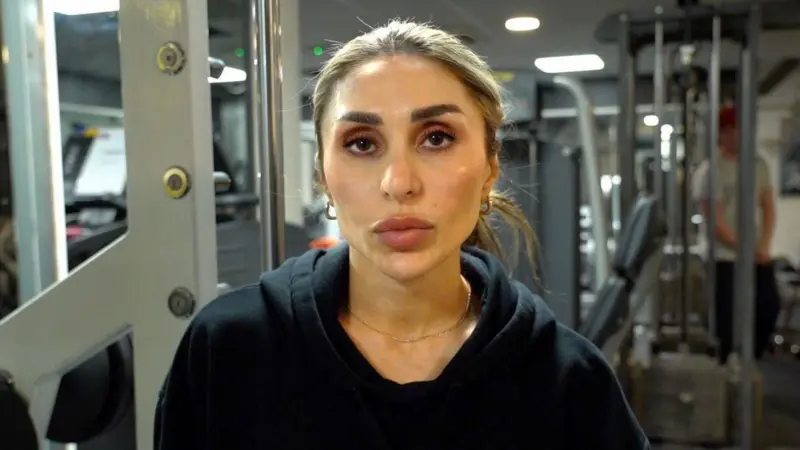
In a world where her voice was once silenced by tradition and her future dictated by others, Roya Karimi has emerged as a symbol of radical transformation. Once a child bride in Afghanistan at the age of 15, she is now standing on the international stage as one of Europe’s premier bodybuilders.
Her journey from the restrictive streets of Kabul to the bright lights of the World Bodybuilding Championships is more than a sporting success; it is a profound reclamation of identity for a woman who was once told she had no right to her own body.
Escaping the Shadow of the Past
Fourteen years ago, Roya made the harrowing decision to flee Afghanistan with her mother and young son. Seeking asylum in Norway, she carried with her the scars of a culture that viewed women’s autonomy as a threat. Today, at age 30, she looks back at her homeland with a mixture of triumph and heartbreak.
“Every time I walk into the gym, I remember my time in Afghanistan,” Roya told the BBC Afghan Service. “I remember when I wasn’t even allowed the freedom to exercise. I was lucky to escape, but so many women there are still denied basic human rights, like education. It is truly tragic.”
Since the Taliban regained power in 2021, the situation for Afghan women has regressed significantly. Girls over the age of 12 are barred from schools, and women are largely prohibited from public spaces, including gyms and parks.
The Body as a Battlefield
For Roya, bodybuilding is not just about aesthetics; it is a form of resistance. In a culture where women are often expected to be invisible—hidden behind veils and confined to the home—Roya chooses to display her strength prominently.
“The authorities in Afghanistan have suppressed the voices of girls to the point where they cannot even go to school,” Roya explains. “They cannot leave the house without a male guardian. They have no right to decide, to think, to express, to love, or to live their own lives.”
By stepping onto the stage in a competition bikini, Roya is intentionally breaking the “invisible boundaries” of tradition, culture, and misinterpreted religious norms. She views her physical strength as a testament to her mental fortitude.
Building a New Life in Norway
The transition to Europe was not easy. Roya had to navigate a new language, a different culture, and the challenges of finding employment. However, she persevered, eventually qualifying as a nurse and working at a hospital in Oslo.
It was during this time that she discovered the gym. What began as a way to manage stress became a path to self-discovery. “Exercise helped me break free from ingrained mental and social limitations,” she says. Her dedication led her to pursue further education, eventually earning a degree in Health and Fitness Science.
Roya and her second husband, Kamal Jalaluddin, are now recognized as Afghanistan’s first professional “fitness couple.” Their partnership represents a shift in the traditional Afghan marriage dynamic, focusing on mutual support and shared goals.
The Road to the World Championships
Roya’s competitive career reached a new peak this year. After winning a gold medal in the Wellness category at the Stoperiet bodybuilding competition, she secured a win at the prestigious Norway Classic 2025.
Unlike categories that focus solely on massive muscle bulk, the Wellness and Fitness categories emphasize:
- Symmetry and Proportion: A balanced, toned physique.
- Natural Aesthetics: Healthy skin tone and graceful stage presence.
- Functional Strength: A display of athletic capability.
Roya competes in a striking green bikini adorned with crystals, her skin bronzed to highlight her muscle definition—a stark contrast to the burqa-clad life she once led. This success has earned her a spot in the European Championships, marking her transition from a refugee to an international elite athlete.
A Support System of Strength
Roya credits much of her professional success to her husband, Kamal, who has been a mainstay in the bodybuilding world for years.
“Seeing Roya on stage is the fulfillment of the dreams we built together,” Kamal says. Roya adds, “Before I met Kamal, I exercised, but not at a professional level. His support gave me the courage to choose this path. I believe that when a man stands by a woman, amazing things can happen.”
The Price of Freedom
Despite her success, Roya’s path has come at a high personal cost. Her family in Afghanistan has largely withdrawn their support, unable to reconcile her public athletic career with their traditional values.
She also faces a barrage of online abuse, including threats of violence and death. Critics often focus on her choice of attire, but Roya remains undeterred.
“People only see the surface—the bikini,” she says. “But behind that are years of suffering, hard work, and perseverance. These successes did not come easily. I chose myself. I worked for a better future.”
Legacy and Hope
Roya uses her social media platforms to connect with Afghan women both inside and outside the country. She speaks to them about physical health, self-confidence, and the importance of reclaiming one’s narrative.
As she prepares for the World Championships on November 27, her message remains clear: her victory is not just personal. It is a step toward redefining the role of women in Afghan society and showing the world that even the most restrictive boundaries can be broken with enough strength and will.





Be First to Comment