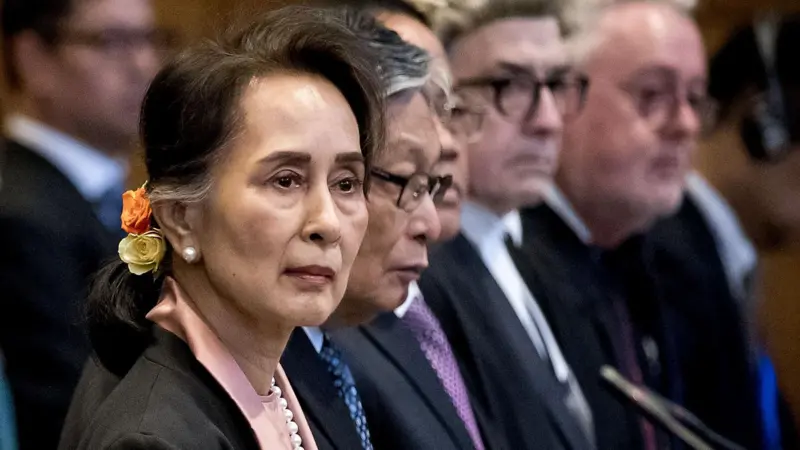
THE HAGUE — As of January 10, 2026, the International Court of Justice (ICJ) is preparing for one of its most significant proceedings to date. The case, initiated by the small West African nation of The Gambia in 2019, accuses Myanmar of violating the 1948 Genocide Convention during military operations in Rakhine State.
For the readers of BurmesePost.com, we have compiled a definitive chronological record of the legal journey that has brought the world’s highest court to the brink of substantive hearings this month.
The 2026 Road Map: Final Oral Arguments
The ICJ has announced a rigorous schedule for oral hearings on the merits of the genocide allegations, set to take place from January 12 to January 29, 2026.
- Jan 12–15: First round of oral arguments by The Gambia.
- Jan 16–20: First round of oral arguments by Myanmar.
- Jan 21–23: Closed-door examination of witnesses and evidence.
- Jan 26–27: Second round of oral arguments by The Gambia.
- Jan 28–29: Second round of oral arguments by Myanmar.
Note: The hearings will be presided over by Judge Yuji Iwasawa of Japan, who succeeded Judge Joan Donoghue as the ICJ President for these proceedings.
Key Developments: 2022 – 2025
July 29, 2025: The Court accepted the intervention of Slovenia, DR Congo, Belgium, and Ireland, allowing them to join the case in support of the genocide allegations.
July 3, 2024: The Court officially accepted the intervention of the Maldives and other allied nations. Myanmar’s previous objections to these third-party interventions were overruled.
May 23, 2024: The Gambia filed its detailed written Memorial (reply) to the Court, solidifying its evidence of systematic intent to destroy the Rohingya group.
July 22, 2022: A landmark victory for the prosecution. The ICJ rejected all of Myanmar’s preliminary objections, ruling that the Court has full jurisdiction and that The Gambia has the legal standing to bring the case.
The Roots of the Case: 2019 – 2021
February 21, 2022: In the wake of the 2021 military coup, a new legal team led by U Ko Ko Hlaing and Daw Thida Oo represented Myanmar at The Hague, replacing the previous civilian-led defense.
January 23, 2020: The ICJ issued a unanimous order for Provisional Measures. Myanmar was legally mandated to:
- Prevent all acts of genocide against the Rohingya.
- Ensure military and police forces do not commit genocide.
- Preserve all evidence related to the allegations.
- Report back to the Court every six months until a final verdict.
November 11, 2019: The Gambia formally filed the case against Myanmar, acting on behalf of the Organization of Islamic Cooperation (OIC).
The 2017 Crisis and Internal Inquiries
The legal battle stems from the “Clearance Operations” launched by the Myanmar military on August 25, 2017, following attacks by ARSA on 30 police outposts.
- UN Findings: The UN High Commissioner for Human Rights described the events as a “textbook example of ethnic cleansing.”
- Mass Graves: In January 2018, the military admitted to the extrajudicial killing of 10 “Bengali terrorists” in Inn Din village, marking a rare admission of violence by security forces.
- The ICOE Report: On January 20, 2020, the Independent Commission of Enquiry (ICOE) submitted its final report to the President of Myanmar, concluding that while war crimes and serious human rights violations occurred, there was “no evidence of genocidal intent.”
What Happens Next?
The upcoming hearings in January 2026 are expected to focus heavily on the intent behind the 2017 operations. While a final judgment could still be years away, the inclusion of multiple European and African nations as intervenors suggests that the international pressure on Myanmar is at an all-time high.
_______
Editor’s Note: The Terminology of “Clearance Operations”
In the context of the Myanmar military (Tatmadaw), the term “Clearance Operations” (translated from the Burmese Nal-Myay Shin-Lin-Yay) is standard doctrinal language. While the English translation may sound like a generic administrative or sanitation task to an outside observer, within Myanmar’s military framework, it is a specific technical term for counter-terrorism and counter-insurgency operations.
Historically, the Tatmadaw has used this phrase to describe tactical maneuvers aimed at “clearing” a defined geographic area of hostile elements, insurgent infrastructure, or “terrorist” threats. In the ICJ proceedings, a central point of contention is whether these “Clearance Operations” were legitimate security responses to insurgent attacks (as argued by the state) or a coordinated campaign of state-led violence (as argued by the prosecution). By using this term, the military is referring to what it defines as a Counter-Terrorist Operation, though international bodies often cite the results of these operations as evidence of ethnic cleansing or genocide.


Be First to Comment