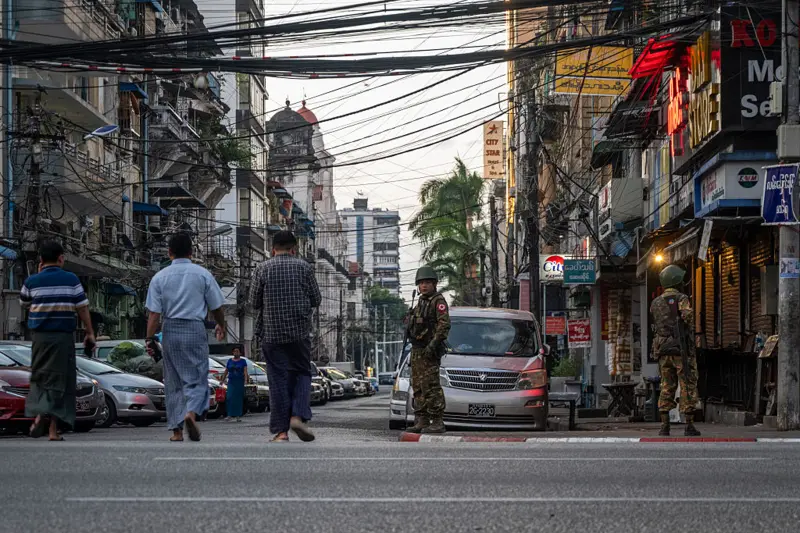
YANGON — The military-appointed Union Election Commission (UEC) launched the second phase of its general election on Sunday, holding polls in 100 townships across Myanmar despite ongoing conflict and heavy security presence.
The polling on January 11 included several volatile regions, such as Min Hla in Bago Region, and Wuntho and Budalin in Sagaing Region—areas where intense fighting has recently led to the suspension of railway services. Voters in major urban centers like Yangon and Mandalay also began casting ballots early Sunday morning under the watch of heavily armed soldiers and police.
In Mandalay, elections were held in nine townships, including Madaya, a town recently retaken by military forces. Local election officials reported that over 1,000 polling stations were opened for this phase, with 536 candidates contesting seats. However, interviews with voters revealed a lack of familiarity with the candidates. “I just came to get it over with early,” said one 30-year-old voter in Maha Aung Myay. “I haven’t decided who to vote for yet; I’ll see when I get inside.”
Senior General Min Aung Hlaing was seen in Yangon on Sunday, visiting polling stations in Hlaing Township to observe the process. According to official reports, Hlaing Township alone has 68 polling stations and over 100,000 eligible voters.
The first phase of the election took place on December 28, 2025, in 102 townships, where the military-aligned Union Solidarity and Development Party (USDP) secured a majority of the seats. That round was marred by criticisms regarding a lack of transparency in advance voting and reports of malfunctioning voting machines.
The Special Advisory Council for Myanmar (SAC-M), a group of former UN human rights experts, issued a statement on January 10 calling the polls “sham elections” and urging the international community to reject them.
“The people of Myanmar have already decided. They have unconditionally rejected the military’s sham election,” said SAC-M member Yanghee Lee. The group warned that failure to stop the process could set a dangerous precedent for democracy globally.
In response to international criticism, military spokesperson Major General Zaw Min Tun previously stated that critics should not be “too quick to judge,” maintaining that the primary goal is to ensure domestic citizens are able to vote regardless of foreign opinion.


Be First to Comment