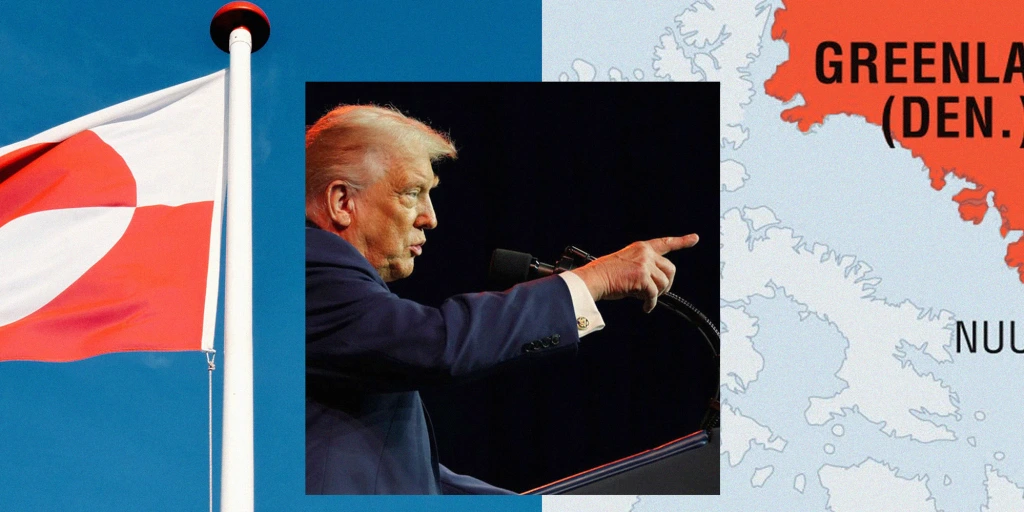
As the White House confirms that “all options,” including the use of military force, are on the table for the acquisition of Greenland, experts are weighing the feasibility of such an unprecedented move between two NATO allies.
According to analysis from defense and legal experts in the U.S., UK, and Denmark, here is a breakdown of the three primary strategies the Trump administration is reportedly considering:
The Military Option: A “Quick but Costly” Operation
While Greenland is geographically vast, its population is tiny (approx. 58,000) and concentrated in a few coastal hubs.
- The Vulnerability: Greenland has no standing army. Its defense is managed by Denmark’s Sirius Patrol, an elite unit that relies on dog sleds to patrol the vast Arctic wilderness.
- The U.S. Foothold: The U.S. already maintains Pituffik Space Base in the northwest. Experts like Hans Tino Hansen (Risk Intelligence) suggest that the 11th Airborne Division based in Alaska, supported by naval assets, could provide the “basic capability” for an invasion.
- The Risk: Former CIA and defense officials warn that this would be a flagrant violation of international law. It would likely lead to the total collapse of NATO and a massive diplomatic backlash from the European Union.
The Purchase Option: “Greenland is Not for Sale”
Secretary of State Marco Rubio has reportedly told Congress that a direct purchase is the administration’s preferred route, echoing Harry Truman’s 1946 offer of $100 million in gold.
- The Financial Hurdle: Analysts estimate the price tag could reach trillions of dollars. For a “President who puts America First,” spending massive amounts of taxpayer money on an icy island could alienate his MAGA base.
- The Legislative Wall: Any treaty for land acquisition requires a two-thirds majority in the U.S. Senate, which currently seems unlikely. Furthermore, both Copenhagen and Nuuk have repeatedly stated that Greenland is a self-governing territory and not a commodity to be traded.
The “Influence Campaign”: Courting Independence
Some advisors suggest a “soft power” approach—encouraging Greenland to declare full independence from Denmark, only to become a U.S. Associated State.
- The Pacific Model: This would mirror the relationship the U.S. has with Palau or the Marshall Islands, where the nations are sovereign but the U.S. manages their defense and citizens get U.S. work rights.
- The Intelligence Factor: Reports suggest U.S. agencies are already identifying influential Greenlandic figures who might support a pro-U.S. independence movement.
- The Reality Check: Polls show that while many Greenlanders want independence from Denmark, very few wish to become part of the United States. Many leaders in Nuuk still view their future as being tied more closely to the European Union.
Summary of Feasibility
| Strategy | Feasibility | Primary Obstacle |
| Military Invasion | High (Tactically) | Destruction of NATO / International Sanctions |
| Direct Purchase | Low | Denmark/Greenland refusal to sell |
| Associated State | Moderate | Lack of local political support in Greenland |
Editor’s Perspective:
As the Trump administration moves into its second year, the tension between “Real Estate Diplomacy” and “Sovereign Law” remains the defining conflict of the Arctic. While the U.S. has the muscle to seize the land, the long-term cost to its global alliances remains the ultimate deterrent.





Be First to Comment